12 posts tagged with "liquidity-providing"

View All Tags

Uniswap v4 Full-Range Positions Keep Paying While SOL/USDC Waits

· 4 min read
DeFi Educator and Strategist

We have written before about how our effectively non-concentrated, full-range Uniswap v4 positions keep doing their job in the background. That is still true.

Meanwhile, some of our concentrated SOL/USDC positions have been priced out by the recent move lower. Could we rebalance them? Yes. But right now that would mean adjusting into weakness and likely locking in a loss just to get active again. So for the moment, we are waiting.

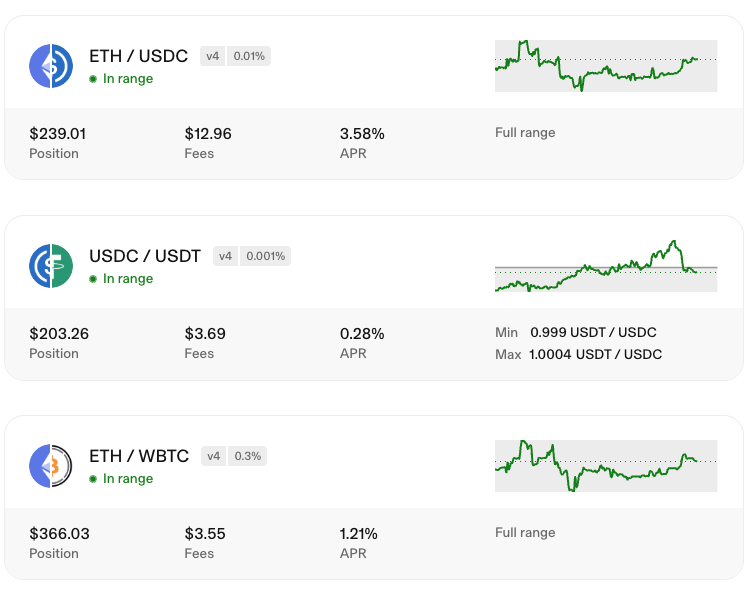
The contrast is worth highlighting: while the SOL/USDC ranges are idle, these two small Uniswap v4 positions on Ethereum are still earning.

Fractured Liquidity on Uniswap: ETH Is Spread Across V2, V3, V4, and Now Even Zero-Fee Competition

· 10 min read
DeFi Educator and Strategist

If you provide liquidity on Uniswap today, you are no longer choosing between "good pool" and "bad pool." You are choosing between versions, fee tiers, hooks, and routing behavior that can all compete for the same order flow.

That is the real state of Uniswap in 2026: ETH and other blue-chip tokens are fragmented across v2, v3, and v4 at the same time, and the trader-facing router is optimized for best execution, not for sending volume to the pool you personally funded.

Orca's New Autoswap Pushes Whirlpools Closer to an LP Service

· 5 min read
DeFi Educator and Strategist

Orca's current Autoswap documentation shows a meaningful product shift. Autoswap no longer feels like a small convenience feature for topping up a position. It now pulls competitive quotes from multiple supported aggregators, lets the LP choose which one to use, bundles the swap and deposit into a single flow, and falls back to a backup route if one option is unavailable.

That matters because it pushes Orca further away from the old "DEX screen plus LP tab" model and closer to something more valuable: an LP service layer built around Whirlpool positions.

DEX Volumes on SOL vs ETH (March 13, 2026): Yes, We Should Still Be Providing Liquidity

· 5 min read
DeFi Educator and Strategist

If you want to know whether liquidity provision still makes sense in March 2026, the first question is simple: is real trading flow still there?

As of March 13, 2026, the answer is clearly yes. DEX traders are still moving billions of dollars a day across Solana, Ethereum, Base, BSC, and Arbitrum. That does not mean every pool is worth touching, but it does mean the raw material for LP returns, swap volume, is absolutely still present.

Should You Be Worried About Providing Liquidity?

· 6 min read
DeFi Educator and Strategist

If you've been following crypto news lately, you might be asking yourself: Should I even be providing liquidity right now?

Web3 is Going Great Webpage Screenshot, Header

The headlines are brutal. Web3 is Going Just Great tracks a constant stream of exploits, rug pulls, and hacks. Just in the past few weeks, we've seen Truebit lose $26 million, Yearn Finance get exploited for the fourth time, and Trust Wallet's browser extension compromised in a supply chain attack. The list goes on and on.

So should you be worried? The honest answer is: Yes, you should be concerned. But that doesn't mean you should avoid liquidity provision entirely.

Uniswap v4 Returns Update: Patience Pays Off

· 5 min read
DeFi Educator and Strategist

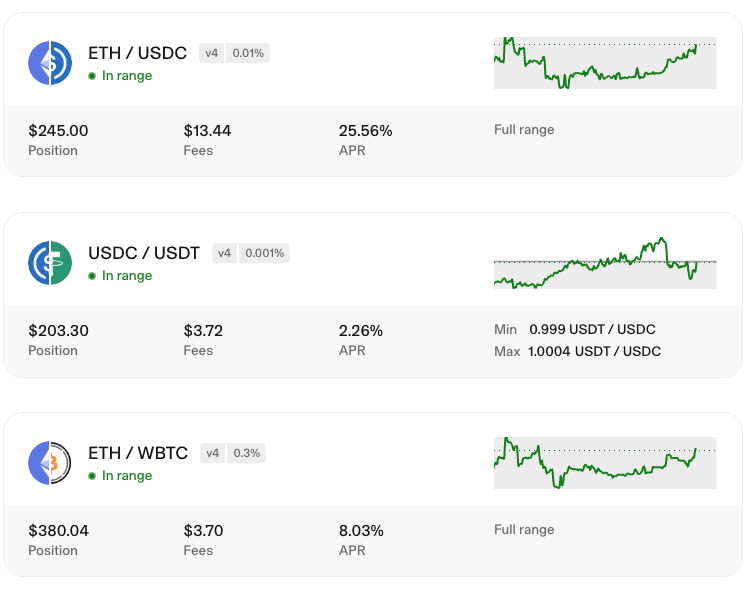
Uniswap v4 Returns Update

Two days ago, we published an analysis of three Uniswap v4 positions showing modest APRs-3.58% on ETH/USDC, 0.28% on USDC/USDT, and 1.21% on ETH/WBTC. Today, those same positions tell a completely different story: 25.56% APR, 2.26% APR, and 8.03% APR respectively.

This dramatic improvement isn't magic-it's what happens when you stay patient with liquidity provision on Ethereum.

What is the Optimal SOL/USDC Concentrated Liquidity Price Range?

· 9 min read
DeFi Educator and Strategist

One of the most common questions we get from liquidity providers is: "What price range should I use for my SOL/USDC concentrated liquidity position?"

The answer isn't simple-it depends on your risk tolerance, time horizon, and market outlook. But by analyzing historical price action, technical levels, and practical LP strategies, we can identify ranges that work for different types of liquidity providers.