16 posts tagged with "defi"

View All Tags

Compound Wants to Turn a Lending DAO Into a Shadow Asset Manager

· 8 min read
DeFi Educator and Strategist

Most DAO treasury proposals are framed as housekeeping. Idle assets should earn something. Stablecoins should not sit around. A committee should professionalize the process. Risk should be managed. Reporting should improve.

What it usually hides is the more important market-structure change: a protocol stops being just a venue and starts becoming a capital allocator in its own right.

That is where Compound is heading.

On April 6, 2026, the Compound Foundation proposed a formal Treasury Management Program and Treasury Management Committee that would start with a $30 million initial treasury envelope, then potentially add the previously approved $8.7 million DAI v2 treasury envelope, undeployed v4 budget amounts, and roughly $11.6 million expected back from the Elixir recovery plus $410,000 from Gauntlet's insurance fund (Compound treasury management proposal).

That is Compound openly preparing to behave less like a lending app with a treasury and more like a treasury with a lending app attached.

Venus Turned One BNB Chain Bug Into a Cross-Chain Borrow Freeze

· 7 min read
DeFi Educator and Strategist

Most exploit coverage stops at the loss number.

That is usually where the real market-structure story begins.

In Venus's case, the headline attack happened on March 15, 2026, when the protocol's THE market on BNB Chain was manipulated through a donation-style exchange-rate attack. But as of April 7, 2026, the more revealing story is what happened after that: Venus had to pause borrowing across all non-BNB-chain deployments, patch core vToken logic, and use treasury plus risk-fund assets to clean up the balance sheet.

That is not just an exploit post-mortem. That is a statement about how fragile multichain money markets still are when they inherit old Compound assumptions and then market themselves as broad, modular liquidity infrastructure.

The market should pay more attention to that second part.

Aave Wants to Turn Liquidation Protection Into a Revenue Product

· 7 min read
DeFi Educator and Strategist

The obvious takeaway from Aave's March 2026 wstETH incident is that oracle mistakes are expensive. That is true, but it is not the interesting part anymore.

The interesting part is what Aave seems to be learning from it.

On March 11, 2026, an Aave governance reimbursement proposal said a CAPO oracle configuration misalignment pushed the reported wstETH/stETH exchange rate cap about 2.85% below the real market rate, triggering erroneous liquidations across 34 accounts and roughly 10,938 wstETH of forced liquidation activity (Aave reimbursement proposal). The same proposal estimated the refund at 512.19 ETH, with the DAO initially eating a net cost of roughly 357.56 ETH, later updated lower as recoveries came in.

That alone is enough to matter. But the more important signal came a few days later.

On March 15, 2026, a new governance proposal introduced the GHO Safety Spoke, an opt-in system designed to automatically use delegated GHO credit to rescue borrowers before liquidation (proposal). The pitch is blunt: every rescue becomes a GHO issuance event that generates revenue for the DAO.

That is not just a safety feature. It is the beginning of a new business model.

Balancer's Permanent Liquidity Pitch Looks Like a Recovery Tax on Future Volume

· 7 min read
DeFi Educator and Strategist

Balancer's latest governance discussion is nominally about recovery. In practice, it is about who pays for survival when a DEX loses trust, TVL, and fee power at the same time.

That is why I think the interesting part of Balancer's current debate is not the headline phrase "protocol-owned liquidity" or "tokenomics revamp." The interesting part is the hidden financing question underneath it: if Balancer wants to rebuild durable liquidity after its November 2025 exploit, does that liquidity come from fresh conviction, or from future users and LPs absorbing a quieter tax through fees, emissions, and weaker economics?

On March 15, Maxis contributor Tanner Uehlein posted a governance thread called "BAL Tokenomics Revamp: Introducing Permanent Liquidity". The core idea is straightforward. Balancer would use a reworked BAL design to build protocol-controlled liquidity rather than rely so heavily on rented mercenary incentives. On its own, that pitch is easy to like. Every mature protocol says it wants stickier liquidity and less dependence on emissions.

But context matters. Balancer is not having this conversation from a position of strength.

Fractured Liquidity on Uniswap: ETH Is Spread Across V2, V3, V4, and Now Even Zero-Fee Competition

· 10 min read
DeFi Educator and Strategist

If you provide liquidity on Uniswap today, you are no longer choosing between "good pool" and "bad pool." You are choosing between versions, fee tiers, hooks, and routing behavior that can all compete for the same order flow.

That is the real state of Uniswap in 2026: ETH and other blue-chip tokens are fragmented across v2, v3, and v4 at the same time, and the trader-facing router is optimized for best execution, not for sending volume to the pool you personally funded.

Spark's Treasury Grab Could Drain DeFi's Best Stablecoin Flow

· 7 min read
DeFi Educator and Strategist

Most of the coverage around Spark's Tokenization Grand Prix has framed it as another bullish milestone for RWAs. That is true, but it is also incomplete.

The more important story for actual DeFi users is that Spark and Sky may be about to tell the market, in size, that idle stablecoin liquidity is worth more in tokenized Treasuries than in the usual onchain reflex loop of lending, farming, and DEX inventory. According to The Defiant's March 18 report, the headline competition budget was $1 billion, but Sam MacPherson argued the real allocation could reach roughly $3.6 billion. The final governance allocation is slated for April 3.

That is not just an RWA headline. It is a pricing signal.

Resolv's USR Hack Shows Why 'Fully Backed' Stablecoins Still Break

· 10 min read
DeFi Educator and Strategist

Resolv's pitch was simple: USR was supposed to be a crypto-backed stablecoin with a delta-neutral design, a separate risk-absorbing layer, and a collateral pool meant to keep the dollar peg credible.

Then on March 22, 2026, an attacker showed the market something more important than the collateral story: if your issuance layer can be broken, your backing story stops mattering almost instantly.

DEX Volumes on SOL vs ETH (March 13, 2026): Yes, We Should Still Be Providing Liquidity

· 5 min read
DeFi Educator and Strategist

If you want to know whether liquidity provision still makes sense in March 2026, the first question is simple: is real trading flow still there?

As of March 13, 2026, the answer is clearly yes. DEX traders are still moving billions of dollars a day across Solana, Ethereum, Base, BSC, and Arbitrum. That does not mean every pool is worth touching, but it does mean the raw material for LP returns, swap volume, is absolutely still present.

DeepWiki: AI-Powered Documentation for DeFi Protocols Like Orca Whirlpools

· 11 min read
DeFi Educator and Strategist

If you're providing liquidity on protocols like Orca, you're essentially trusting smart contracts with your money. But how do you actually know what those contracts are doing? Most of us aren't programmers, and even if we were, diving into a massive codebase with thousands of files written in Rust and TypeScript is overwhelming.

That's where DeepWiki comes in. It's a tool from Cognition AI that automatically reads through GitHub repositories and creates documentation that normal people can actually understand. Instead of staring at code wondering what it does, you get a wiki-style guide with explanations, diagrams, and even a chat feature where you can ask questions.

Think of it like having a technical writer who's read every line of code and can explain it to you in plain English. DeepWiki scans the repository, figures out how everything connects, and presents it in a way that makes sense. You can ask questions like "How does fee accumulation work?" and get answers that point directly to the relevant code, so you can verify what you're being told.

Should You Be Worried About Providing Liquidity?

· 6 min read
DeFi Educator and Strategist

If you've been following crypto news lately, you might be asking yourself: Should I even be providing liquidity right now?

Web3 is Going Great Webpage Screenshot, Header

The headlines are brutal. Web3 is Going Just Great tracks a constant stream of exploits, rug pulls, and hacks. Just in the past few weeks, we've seen Truebit lose $26 million, Yearn Finance get exploited for the fourth time, and Trust Wallet's browser extension compromised in a supply chain attack. The list goes on and on.

So should you be worried? The honest answer is: Yes, you should be concerned. But that doesn't mean you should avoid liquidity provision entirely.

Orca xORCA Staking: Attractive Yields When ORCA is Priced Right

· 6 min read
DeFi Educator and Strategist

Orca's xORCA staking offers a unique way to earn yield on your ORCA tokens by aligning your interests with the protocol's success. Unlike traditional staking that locks your tokens, xORCA is a liquid staking token that grows in value over time as the protocol buys back ORCA with trading fees.

Here's what makes xORCA staking attractive - and why buying ORCA at reasonable prices can significantly boost your effective yield.

xORCA Staking Metrics - January 2026

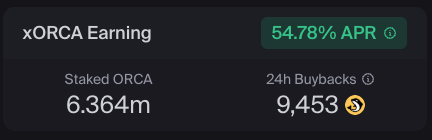
As of January 2026, xORCA staking is showing impressive yields exceeding 50% APR, with over 6.3 million ORCA staked and significant daily buybacks driving the exchange rate growth.

Uniswap v4 Returns Update: Patience Pays Off

· 5 min read
DeFi Educator and Strategist

Uniswap v4 Returns Update

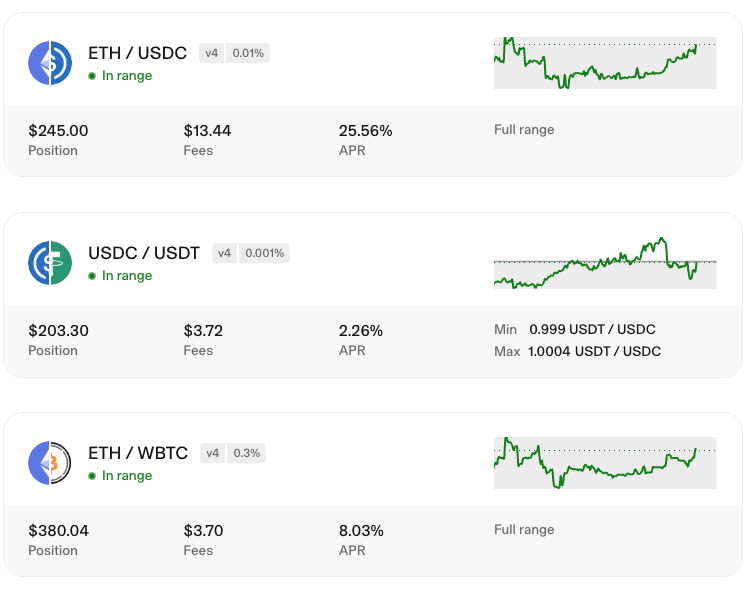
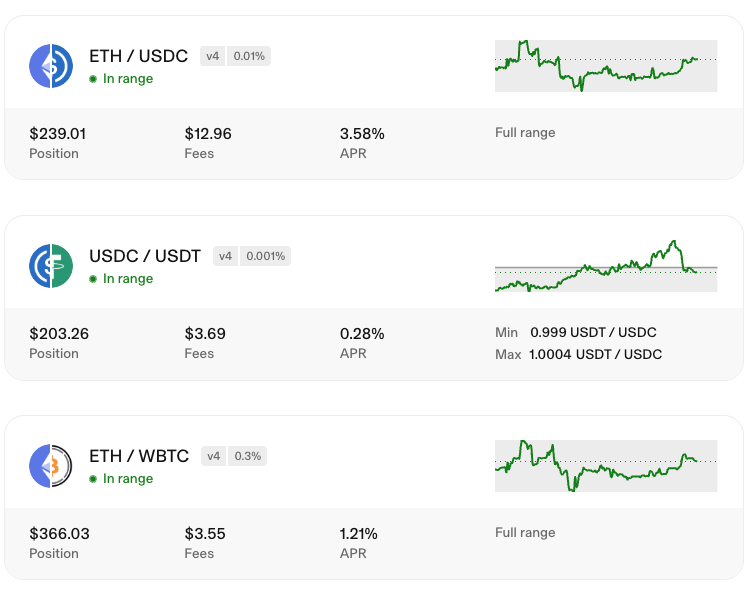
Two days ago, we published an analysis of three Uniswap v4 positions showing modest APRs-3.58% on ETH/USDC, 0.28% on USDC/USDT, and 1.21% on ETH/WBTC. Today, those same positions tell a completely different story: 25.56% APR, 2.26% APR, and 8.03% APR respectively.

This dramatic improvement isn't magic-it's what happens when you stay patient with liquidity provision on Ethereum.