8 posts tagged with "fees"

View All Tags

Uniswap v4 Full-Range Positions Keep Paying While SOL/USDC Waits

· 4 min read
DeFi Educator and Strategist

We have written before about how our effectively non-concentrated, full-range Uniswap v4 positions keep doing their job in the background. That is still true.

Meanwhile, some of our concentrated SOL/USDC positions have been priced out by the recent move lower. Could we rebalance them? Yes. But right now that would mean adjusting into weakness and likely locking in a loss just to get active again. So for the moment, we are waiting.

The contrast is worth highlighting: while the SOL/USDC ranges are idle, these two small Uniswap v4 positions on Ethereum are still earning.

Raydium LaunchLab's Fee Stack Is Turning Solana Token Launches Into a Higher Hurdle Race

· 7 min read
DeFi Educator and Strategist

Most coverage of Solana launchpads still treats fees like side details.

That framing is obsolete.

As of April 5, 2026, Raydium's LaunchLab documentation and related analytics make the more important point hard to ignore: launching and trading a new token on Solana is increasingly an additive fee stack, not a simple AMM event.

The reason this matters is not just that traders pay more. The deeper market-structure consequence is that by the time a token graduates into a live liquidity pool, the market may already be carrying a larger hidden cost basis than many LPs and traders realize.

That changes what post-migration liquidity has to do in order to feel healthy.

PancakeSwap's Stablecoin Fee Change Quietly Turns LP Flow Into Treasury Dry Powder

· 8 min read
DeFi Educator and Strategist

Most DeFi fee changes are sold as minor plumbing. That is usually when they matter most.

PancakeSwap's February 2026 proposal to retain treasury-bound fees from major stablecoin pools in stablecoins instead of first converting everything into CAKE sounds administrative on the surface. The proposal says the current path forces unnecessary round-trip conversions, creates operational friction, and exposes the treasury to avoidable CAKE volatility (PancakeSwap forum, February 19, 2026).

That is all true. It is also incomplete.

The more interesting point is that PancakeSwap is quietly telling the market that symbolic buyback reflexes matter less than holding spendable balance-sheet liquidity. In plain English: a meaningful slice of the venue's stablecoin trading activity is no longer there to support automatic CAKE conversion optics. It is being trapped upstream as treasury dry powder.

According to the proposal, fees from these stablecoin pools represented roughly 29% of total treasury revenue over the past year. The change applies across v2, v3, StableSwap, and Infinity, and after a clarification on February 25, 2026, the scope covered stablecoin pools containing USDT, USDC, USD1, or U (forum clarification).

That is not a tiny configuration change. That is a statement about what kind of DEX PancakeSwap thinks it needs to be in 2026.

Balancer's Permanent Liquidity Pitch Looks Like a Recovery Tax on Future Volume

· 7 min read
DeFi Educator and Strategist

Balancer's latest governance discussion is nominally about recovery. In practice, it is about who pays for survival when a DEX loses trust, TVL, and fee power at the same time.

That is why I think the interesting part of Balancer's current debate is not the headline phrase "protocol-owned liquidity" or "tokenomics revamp." The interesting part is the hidden financing question underneath it: if Balancer wants to rebuild durable liquidity after its November 2025 exploit, does that liquidity come from fresh conviction, or from future users and LPs absorbing a quieter tax through fees, emissions, and weaker economics?

On March 15, Maxis contributor Tanner Uehlein posted a governance thread called "BAL Tokenomics Revamp: Introducing Permanent Liquidity". The core idea is straightforward. Balancer would use a reworked BAL design to build protocol-controlled liquidity rather than rely so heavily on rented mercenary incentives. On its own, that pitch is easy to like. Every mature protocol says it wants stickier liquidity and less dependence on emissions.

But context matters. Balancer is not having this conversation from a position of strength.

Polymarket's New Fee Curve Is Quietly Taxing the Middle

· 7 min read
DeFi Educator and Strategist

On March 6, 2026, Polymarket extended taker fees and maker rebates to all crypto markets, not just the short-dated contracts it started with in January. That sounds like a small product update. It isn't.

The undercovered story is that Polymarket has now made a very explicit decision about where it wants liquidity to be and how it wants makers to quote risk. If you provide liquidity, trade prediction-market crypto contracts, or study onchain market structure, this matters more than the headline.

Why Orca's Transparent Fees Beat Jupiter's Hidden Costs

· 7 min read
DeFi Educator and Strategist

When you swap SOL, USDC, or mSOL on Orca, you know exactly what you're paying. The fee structure is transparent, predictable, and fair-especially for the common trades that most users make every day. Orca's fee settings have never been an issue for these standard pairs.

Meanwhile, aggregators like Jupiter (jup.ag) have been layering hidden fees, integrator cuts, and priority tips on top of swaps, making the effective cost to users orders of magnitude higher than Solana's minuscule base fees. Let's break down why Orca's approach is better-and why Jupiter's fee mechanics are ripping people off.

Orca Trading Fee Configuration

Uniswap v4 Returns Update: Patience Pays Off

· 5 min read
DeFi Educator and Strategist

Uniswap v4 Returns Update

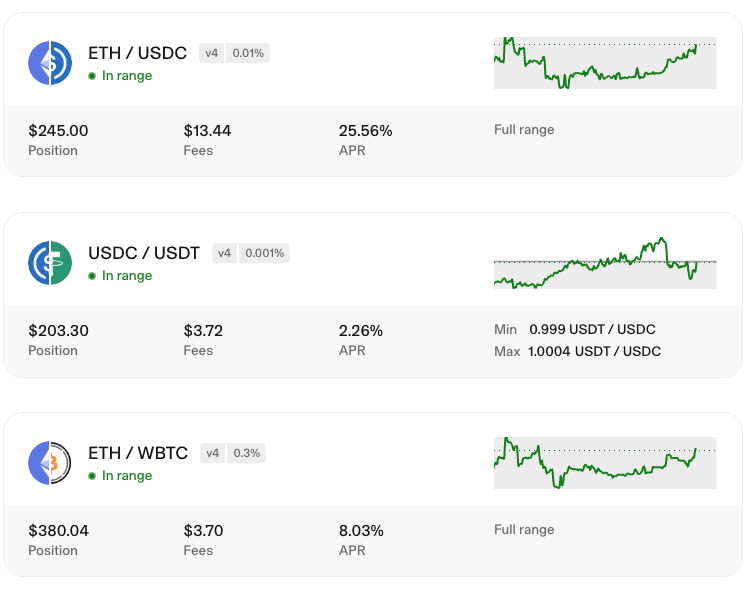
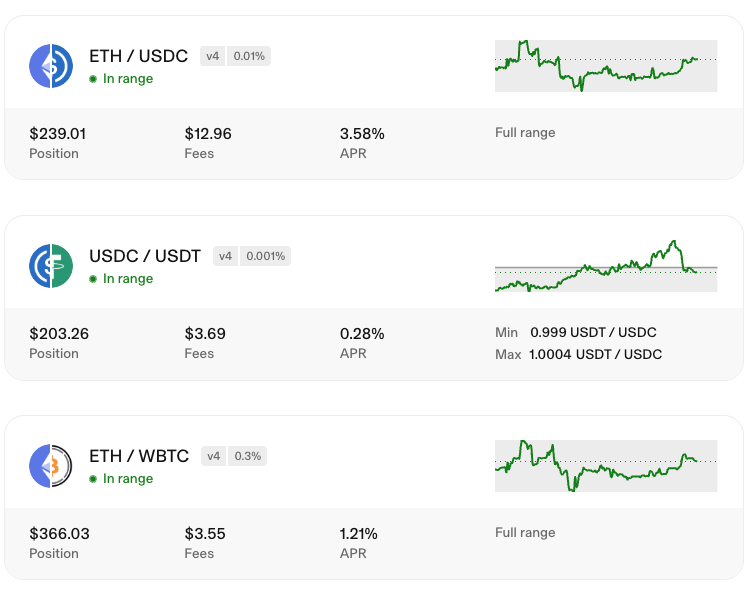
Two days ago, we published an analysis of three Uniswap v4 positions showing modest APRs-3.58% on ETH/USDC, 0.28% on USDC/USDT, and 1.21% on ETH/WBTC. Today, those same positions tell a completely different story: 25.56% APR, 2.26% APR, and 8.03% APR respectively.

This dramatic improvement isn't magic-it's what happens when you stay patient with liquidity provision on Ethereum.