💸 Gas Fees and Transaction Costs
Even on low-cost chains like Solana, fees can quietly eat into profits-especially if you're managing liquidity positions with high frequency or interacting with dApps that don't optimize for transaction efficiency.
Why Gas Fees Matter
Each time you adjust your LP range, withdraw rewards, or rebalance your portfolio, you're triggering on-chain activity. If you're using tools or interfaces that default to max-priority fees or bundle more operations than necessary, those small fees add up fast.
The Hidden Cost of Active Management
Active liquidity providers who rebalance frequently can see significant fee erosion:
- Range adjustments: Every time you move your concentrated liquidity range
- Reward claims: Withdrawing earned fees and incentives
- Rebalancing: Adjusting positions across multiple pools
- Protocol interactions: Staking, unstaking, voting, etc.
On high-fee chains like Ethereum mainnet, a single transaction can cost $50–$200+ during network congestion. If you're making multiple transactions per week, fees can easily consume 5–10% of your annual returns.
Chain-Specific Considerations
Ethereum Mainnet
High fees, high security
- Gas costs: $10–$200+ per transaction (varies with network congestion)
- Best for: Large positions where fees are a small percentage
- Mitigation: Use Layer 2s for active strategies
Layer 2s (Arbitrum, Optimism, Base)
Lower fees, Ethereum security
- Gas costs: $0.10–$2 per transaction
- Best for: Active management and frequent rebalancing
- Popular options: Arbitrum, Optimism, Base
Solana
Very low fees, high throughput
- Transaction costs: $0.00025–$0.01 per transaction
- Best for: High-frequency strategies and active management
- Note: Even on Solana, fees can add up with frequent transactions
Other Chains
Different chains have different fee structures. Always factor transaction costs into your strategy, especially if you plan to rebalance frequently.
Mitigation Strategies
🧠 Be Conscious of Default Settings
Some platforms use conservative or inflated compute budgets or prioritize speed over cost. Check your transaction settings and adjust compute budgets or priority fees when possible.
What to look for:
- Adjustable compute budgets (Solana)
- Priority fee settings (Ethereum)
- Transaction simulation before execution
- Fee estimation before confirming
⚠️ Jupiter Can Quietly Cut Into Solana LP Returns
Jupiter is not where you place liquidity positions directly. You are not opening an Orca Whirlpool or Meteora position inside Jupiter.
But Jupiter still matters for LPs because many people use it to:
- swap claimed rewards into
SOL,USDC, or another base asset, - rebalance after withdrawing fees,
- consolidate emissions from multiple protocols,
- rotate out of smaller reward tokens.
That is where the hidden cost shows up.
If you are swapping rewards through Jupiter's default interface and not paying attention to the fee settings, you can quietly give back a meaningful part of your LP profits. This is especially true for smaller harvests, where a few extra cents per swap can erase a surprising share of the edge you thought you earned.
As Kinda Lame argued in this write-up, the issue is not that Jupiter is unusable. The issue is that many users accept the default routing and fee behavior without asking whether they actually need it.
If all you are doing is turning ORCA, RAY, or another reward token back into USDC, speed-maximized routing may be overkill. The trade settles, but your LP math gets worse.
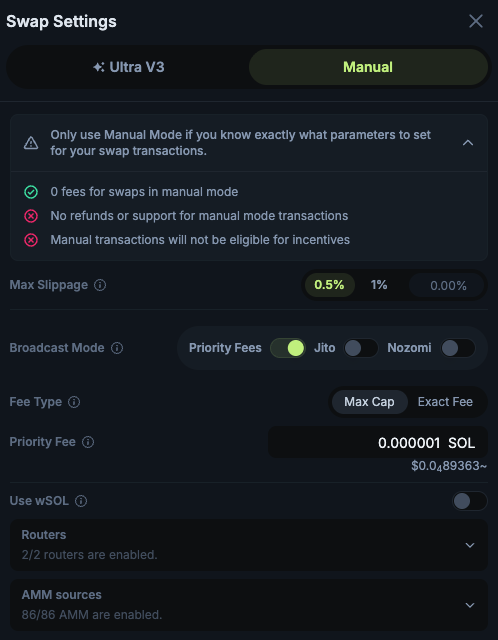
What to watch for on Jupiter
- Priority fees left on by default when you do not need urgent inclusion
- Jito or other broadcast options enabled even for routine reward swaps
- Fee caps or exact-fee settings that are higher than necessary for a non-urgent transaction
- Repeated small swaps instead of batching rewards into fewer conversions
For an LP, this matters because reward harvesting is usually supposed to be a low-drama maintenance step. If the interface adds avoidable costs every time you convert emissions, your real APY is lower than the protocol dashboard suggests.
The practical takeaway
If you use Jupiter to swap rewards:
- Check whether you actually need the default speed settings.
- Review priority fee settings before confirming.
- Be especially careful on small reward swaps, where fixed costs matter more.
- Compare the value you are converting against the fee you are about to pay.
The point is not "never use Jupiter." The point is that LPs should treat reward-swapping costs as part of position management, just like gas, slippage, and rebalance frequency.
🪙 Avoid Frequent Transactions on Third-Party Frontends
Third-party frontends that don't let you configure compute budget, priority fees, or transaction structure can cost more than necessary. Favor native protocol interfaces when possible.
Better options:
- Use official protocol websites (e.g., Orca.so)
- Direct contract interactions (for advanced users)
- Tools that let you customize fees
🧩 Favor Native Solana Protocols
Native Solana protocols (like Orca.so) are optimized for low compute and cost-effective swaps. They're designed to minimize transaction costs while maintaining functionality.
⚖️ Batch Multiple Operations
Consider batching multiple LP updates or using programmatic access to customize fees and cut costs. Instead of making 5 separate transactions, combine them into one.
Batching strategies:
- Update multiple positions in one transaction
- Claim rewards when you're already making a transaction
- Group related operations together
🛡️ Don't Rebalance Daily
Let fees compound before intervening. Frequent rebalancing can eat into your returns, especially on high-fee chains. Only rebalance when necessary, not on a fixed schedule.
When to rebalance:
- Price moves significantly outside your range
- You've accumulated enough fees to justify the gas cost
- Market conditions have fundamentally changed
- Not: Every day, every week, or on a fixed schedule
🧪 Simulate Transactions First
For highly active LP strategies, simulate transactions to assess actual fee impact before deploying at scale. Many protocols and wallets offer transaction simulation.
💡 Use Layer 2s for Active Strategies
If you're planning to actively manage positions, consider using Layer 2s like Arbitrum or Optimism for lower fees. You get Ethereum security with much lower transaction costs.
When Layer 2s make sense:
- Frequent rebalancing
- Active range management
- Small to medium position sizes
- When gas costs would eat into returns
🎯 Choose Gas-Efficient Protocols
Some protocols are designed to minimize gas costs:
- Uniswap V3/V4: More gas-efficient than V2
- Orca: Optimized for Solana's low fees
- Curve: Efficient for stablecoin pairs
Calculating Fee Impact
To understand if fees are eating into your returns:
- Track your transaction costs over a month
- Calculate your total fees as a percentage of your position
- Compare to your earned fees - Are you net positive?
- Adjust your strategy if fees are too high
Example:
- Position size: $10,000
- Monthly gas costs: $200
- Monthly earned fees: $150
- Result: You're losing money to fees
In this case, you'd need to either:
- Increase position size
- Reduce transaction frequency
- Move to a lower-fee chain
- Wait longer between rebalancing
Best Practices Summary
- Factor fees into your strategy - Don't ignore transaction costs
- Use Layer 2s for active management - Lower fees enable more frequent rebalancing
- Batch operations - Combine multiple actions into single transactions
- Don't over-rebalance - Let fees compound before intervening
- Choose efficient protocols - Some protocols are more gas-efficient than others
- Monitor fee impact - Track costs vs. returns
- Adjust compute budgets - On Solana, optimize compute usage
- Use native interfaces - Official protocol sites are often more efficient
Related Resources
- Risks Overview - Complete guide to all LP risks
- Chain Guides - Understand chain-specific fee structures
- Protocol Guides - Learn about gas efficiency on specific protocols
- Strategies Overview - LP strategies that account for fees
Next: Other Risks →